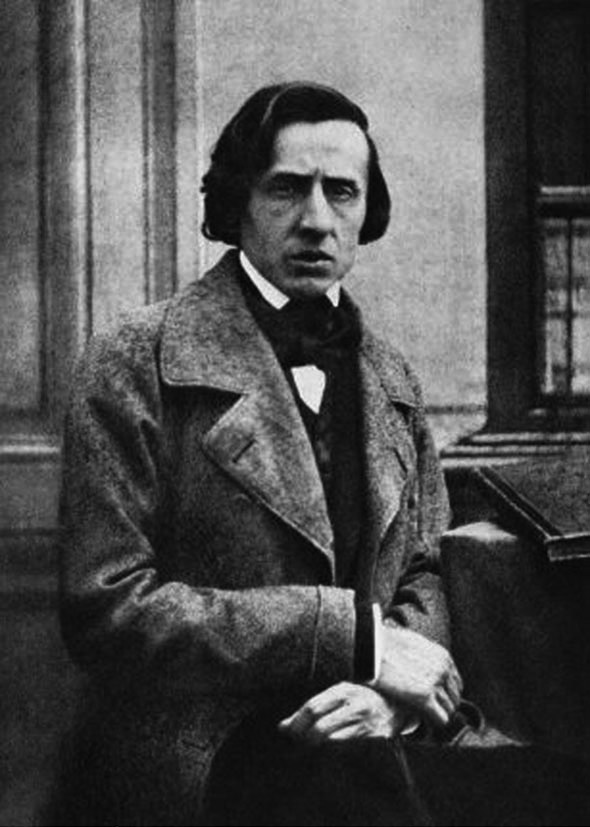
Oh Frederic Chopin, how I adore thee, despite the fact that you are now officially 200. I don't care what you said about your birthday being March 1st, the church records say February 22nd. Humorous and observant, romantic to the core, full of strange habits - his pieces, some of the most descriptive and lyrical ever written, were never given titles but were always identified by genre and number. His sickly, tuberculosis-threatened exterior could not hide the exuberance and passion that lay within his soul. No other man in history, it could be argued, has devoted himself so fully to anything as Chopin devoted himself to the piano. He brought revolutionary ideas into his pieces, rubato, dissonance, chromatics...yet at the same time they were timeless classics that refined technique and musical character. His innovation led to some of his contemporary's most renowned works, such as Liszt's Transcendental Etudes. He was altogether French and yet wholly Polish. He had a turbulent relationship with George Sand [whom I, though I know little of her, detest] that lasted until the end of his tragically short life.
A Guide to Chopin's Music
Begin with the classics; everyone knows them. Fantasie Impromptu. Revolutionary Etude [Op. 10 no. 12]. The posthumous nocturne in C-sharp minor. The minute waltz. Pieces that have earned themselves names that Chopin did not give.
Move on to more sophisticated fare. Chopin's etudes stand as a landmark in musical history today. He was the first to really make the etude a piece fit to be performed, not merely for technical purposes. He seemed to have an etude to cover everything: black keys, thirds, sixths, octaves, arpeggios...check out the Winter Wind Etude [Op. 25 no. 11] Butterfly Etude [Op. 25 no. 9] Etude Op. 10 no. 4...but by far my favorite is Op. 10 no. 9. It's not difficult, it's not long...in fact it is considered the easiest etude...but its melody is so beautiful. The piece is written in a variant of f-harmonic minor. Absolutely haunting.
Check out Chopin's concertos. He can write as well for the orchestra as he could for the piano. Both are beautiful, but listen to the first movement of his first concerto and second movement of the second concerto.
The word scherzo means "joke". Scherzos before Chopin's time were usually short, flippant children's pieces. Chopin took the traditional scherzo, as he did with everything else, and made it his own. All four scherzi are pretty well known...listen to the middle section of the second one and the first one is essential to your Chopin knowledge.
There's the "Chopin scherzo", then there's the "Chopin ballade." I've played the three hardest of the four, and all are gorgeous pieces. Listen to the first for the rubato and the way he repeats a theme over and over. The second, though well known, is really not necessary; it's a piece for light listening. My ABSOLUTE favorite is the fourth. It's extremely difficult, but I determined, when music major I invited to give me a lesson on a different piece played it, that I would learn it and master it someday. The very opening theme captivated me. I have this theory that Liszt is twice guilty of plagiarizing Chopin's work. Don't get me wrong, I adore the Hungarian almost as much the Frenchman, but compare the main theme of the fourth ballade to the main theme of Liszt's La Leggierezza, Second Concert Etude...I played the two in short succession, and couldn't help noticing the similarities. The other instance is with Liszt's 10th transcendental etude, Allegro Agitato Molto, and Chopin's Op 10 no 9 etude [how dare you Franz, how dare you.]
Try to get in a few of the "Chopin nocturnes" in as well. Op. 27 no. 2 is short and sweet and well known. Squeeze in the first Impromptu if possible, as well as the Barcarolle in F sharp major, and finish it off with the grand first movement of Chopin's 3rd sonata.
One cannot do justice to the great Chopin without really playing his music, experiencing his genius firsthand, but that is the grandeur of music, and all other art; those who cannot make it can nevertheless enjoy it just as thoroughly.
bon anniversaire.

i love chopin!!!! :):):):).
ReplyDeleteand i love your expertise aha.
so because of this post, i went back and looked at my old piano books, and i realized that in one of my books, i'd learned every single song... aside from his.
ReplyDeleteah. that makes me feel incomplete.